The blog · Fall 2026
In 2001 the whole country moved in days. What it's waiting on now isn't agreement.
A note before this starts: I was in New York that morning. This piece is partly mine rather than the record's, and it should be read that way.
I saw the first tower hit from the N train, above ground in Queens.
I told my roommate not to freak out, but I thought one of the trade centers was on fire. She said oh my god loudly enough that the rest of the car got up and crossed to the south-facing windows.
Then we went into the tunnel toward Grand Central. We went in with a fire and came up with an attack.
By the time I got upstairs to the 48th floor of One Dag Hammarskjöld Plaza, across the street from the United Nations, the second tower had been hit. Nobody sat down at a desk. Everyone on the floor ended up in one office, watching from the windows, about four miles off as the crow flies.
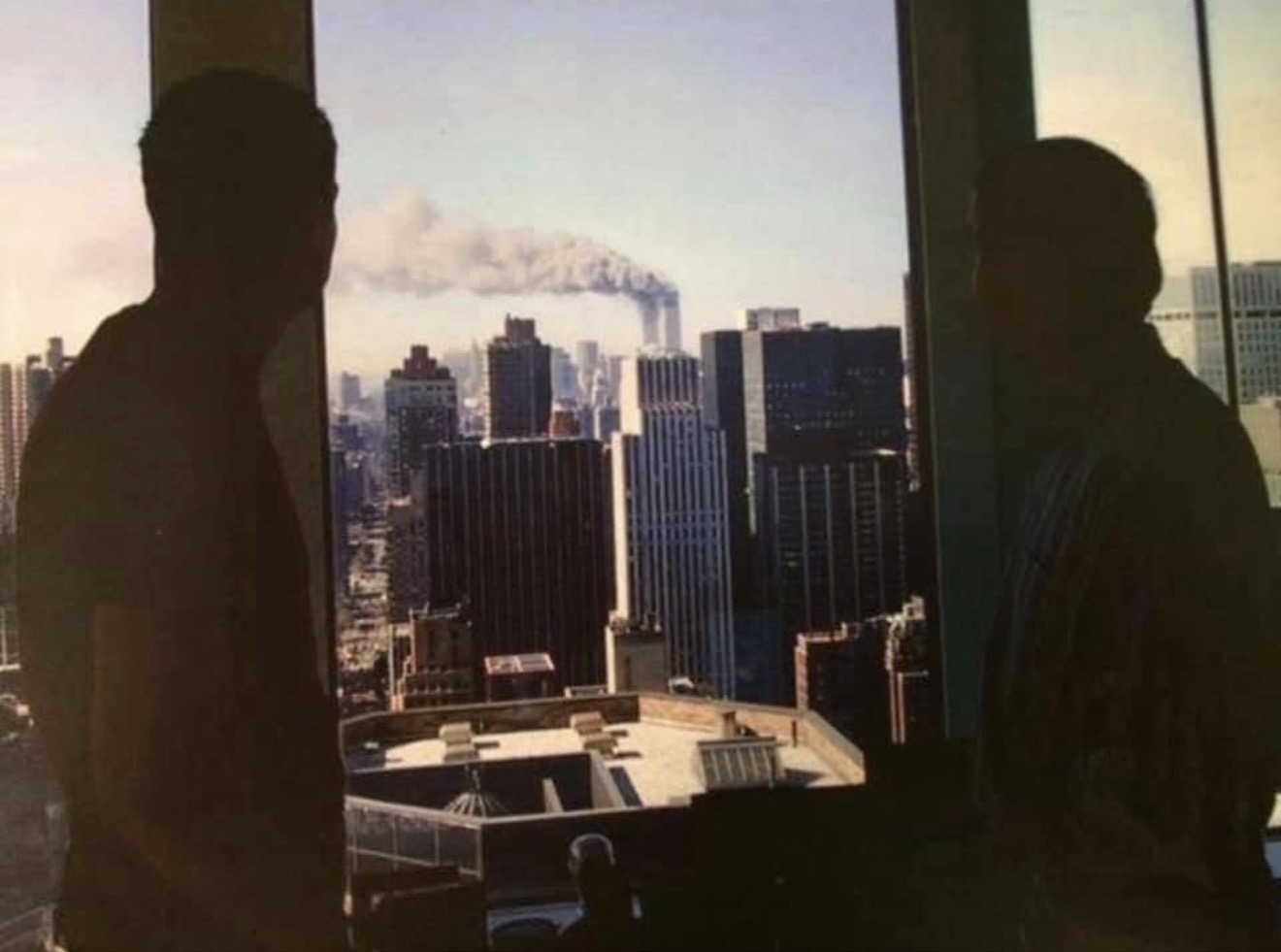
What I remember most isn't the towers. It's later that day, when it settled in that nobody knew who had done this or whether more was coming — and we were next door to the UN, which was a reasonable guess for whatever came next.
But what came next was the reality of it all. Workmates crying. A phone call to my mom. The anthrax scares. And the construction boards where the ads used to go, filling up with home-printed flyers, then filling up again the next day, all of them faces, all of them missing.
My story is the same as a million others from that day. Confusion, then fear, then anger, then fear again, then sorrow, then fear. I'll leave it there.
What happened in Washington
Washington moved just as fast.
The same weeks, in Washington, the machinery that usually takes years took days.
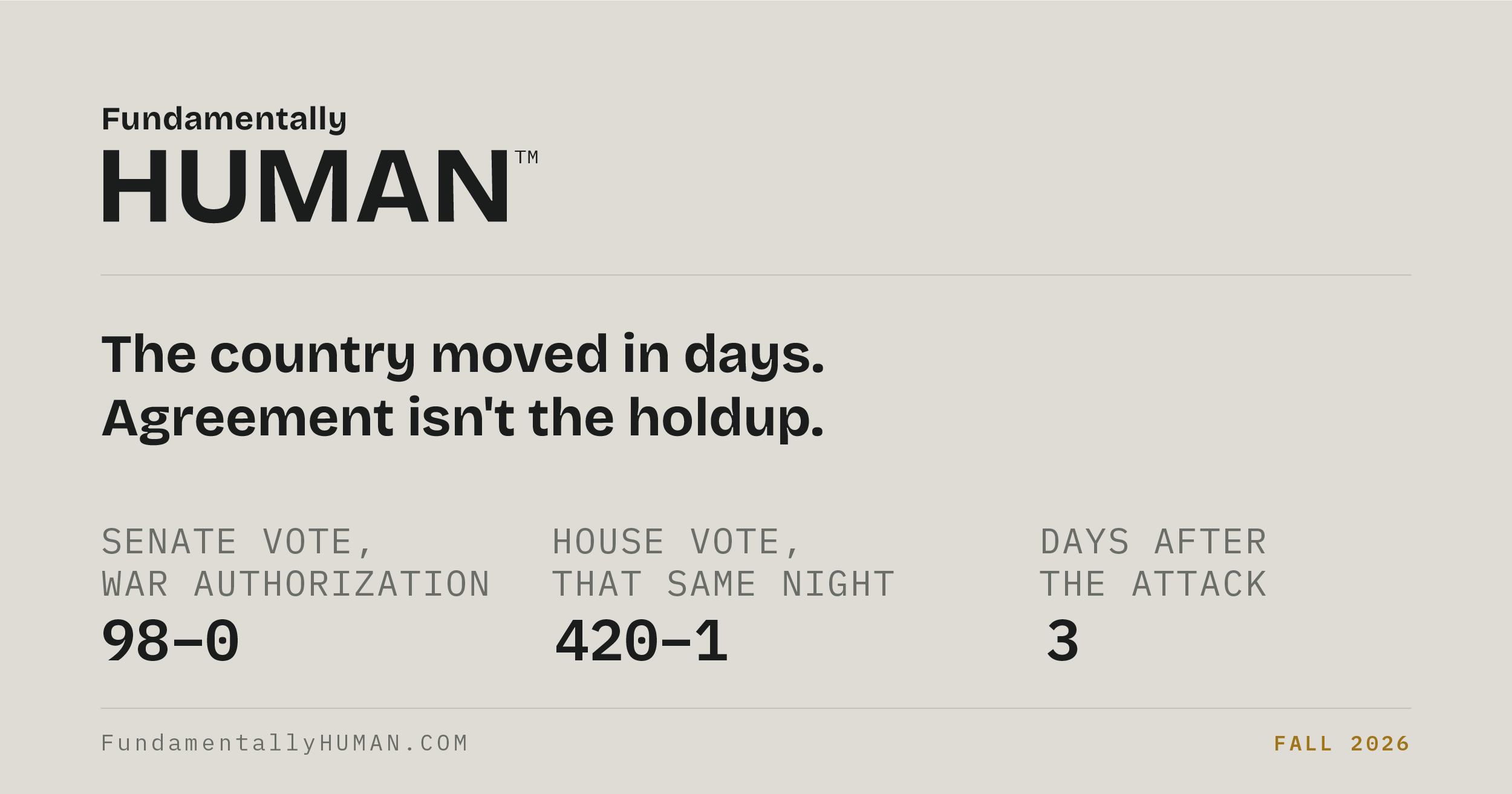
The authorization to use military force was introduced on September 14. The Senate passed it that day, 98 to 0. The House passed it that night, 420 to 1. Three days after the attack. It was signed on September 18.
The surveillance law took longer to arrive and no longer to pass. The final bill was introduced on October 23. The House approved it the next day, 357 to 66. The Senate approved it the day after that, 98 to 1. The President signed it on October 26.
There's a detail in the House's own historical record worth sitting with. Congressional staff had been displaced by the anthrax scare and were working without their offices — on the floor, writing on legal pads, cutting and taping pages together to send to the printer. That is how the final text was assembled. Roughly three hundred pages, put together by hand, introduced one day and passed the next.
It's worth being clear about who was casting those votes. The anthrax letters were an attack on Congress itself, delivered by mail, from a source nobody had identified yet. The people voting weren't watching the fear from somewhere safe. They were inside it, the same as the rest of us.
Whether those were good laws is not what this piece is about, and I'm not going to tell you what I think of them. People have argued about both for twenty-five years and that argument is available everywhere. What matters here is only this: the government demonstrated, on the record, in public, that it can move from nothing to enacted law inside of three days.
The objections, which are serious
Four, and the last one is the strongest.
- That unity was fear and anger. Some of it was also real, and I want to be fair to it. For at least a month in New York people were kinder — more considerate, quicker to give way, more willing to talk to a stranger. Ask anyone who was there. Something genuine happened between people. But it sat on top of fear. I don't know whether the kindness came from understanding that the person next to you might be going through something unspeakable, or from something older than that, the way people close ranks when they're frightened. Probably both. Either way, anyone selling nostalgia for September 2001 is selling the fear along with it, whether they say so or not. And I was as angry as anyone. It felt like clarity at the time.
- Speed is not a virtue. Neither is doing nothing. A bill assembled by hand and voted on the next day is not a model for how to legislate. Some of what passed in those weeks was revisited, narrowed, litigated, and in places allowed to expire. This piece claims only that the institution moved. It makes no claim that it moved well.
- The two laws aren't the same story. The military authorization was two pages. The surveillance law was three hundred. Passing a short authorization in a day proves less than it looks like it proves. The honest version is that both moved at a speed the same institution does not otherwise reach.
- Nothing since has been that urgent. True, and it's the strongest objection. Crisis creates a permission that ordinary politics doesn't have. Nobody should expect a Tuesday in an ordinary year to move like September 2001.
What holds up
The country still agrees. That part works.
That's not sentiment — it's what the record on this site measures. Fifteen topics, all sitting between 65 and 86 percent support, with majorities of Republicans and majorities of Democrats, measured by national pollsters that publish their methods and their tables. Fifteen things Americans overwhelmingly agree on, with no clean law to show for most of them. Nobody organized that. No campaign produced it. Americans arrive at the same conclusions on their own, and they keep doing it year after year while being told constantly that they're divided.
Washington is the part that's idle.
And the useful thing about 2001 is that it took the excuse off the table. Washington is not slow because slowness is built into it. It is not stuck because the country can't make up its mind. It moved from nothing to law in three days, twice, in front of everyone, and then went back to a pace where topics with 80 percent support sit for years without a vote.
So the question the record asks isn't why Americans can't agree. Americans agree. It's in the data on the page.
The gap
What September had that these fifteen don't isn't more agreement. It's expectation.
The country agreed, and it expected its lawmakers to act, and every member of Congress casting one of those votes understood that doing nothing would cost them. The agreement and the expectation arrived together. That combination is what moves an institution in three days.
On the fifteen topics, the agreement is there and the expectation isn't. Eighty percent of the country wants a thing. Nobody is waiting to see whether it happened. Nothing follows for anyone if it doesn't.
That's the gap. Not agreement. Agreement with expectations attached to it.
And nothing is coming to supply it. There is no event on its way that will make child care urgent the way September made those two bills urgent, and nobody should want one. Whatever moves those fifteen has to get built in ordinary weeks, by people deciding on a Tuesday that agreement ought to come with a bill attached to it.
That's the part that mattered then, and it matters more now. In 2001 the expectation showed up on its own, carried in on fear. It won't do that again, and waiting for it to is the same as deciding nothing happens.
Something to do
Pick the topic you care least about.
Not the one you feel strongly about. The one you'd have guessed was controversial and isn't. Look up where your own representative stands on it. Not their party. Them.
If it turns out they agree with 80 percent of the country and nothing has happened, that's the whole project in one afternoon, and you found it yourself.
Where these came from
- Congress.gov — S.J. Res. 23, every action and date. Introduced and passed by both chambers 14 September 2001, signed 18 September 2001. Public Law 107-40.
- Congress.gov — H.R. 3162, every action and date. Introduced 23 October, House 24 October, Senate 25 October, signed 26 October 2001.
- U.S. House of Representatives History, Art & Archives — the account of staff displaced by the anthrax scare assembling the final text by hand.
- Congressional Record, Volume 147 (2001) — the vote counts.